Hidden Daughters


The Program
For some European daughters of Pakistani immigrants there are daily struggles to find a balance between cultures.  When conflicts turn to culture wars in the family the daughters may disappear - sometimes forever when they are sent back to their parents' native land to be "re-educated."  Attempting to shed light on the girls' destinies, Hidden Daughters travels to Pakistan in search of one girl who suddenly disappeared.  Thought by friends and teachers to be going on a holiday, no one has heard from her in a year.  And there is good reason to be worried. In Pakistan many women are locked away, they are forced into marriage, and they suffer from suppression, physical and psychological abuse.

Learn More...
Hidden Daughters only hints at the violence often directed against Islamic women. Perhaps nowhere is the problem more acute than in Pakistan. The Human Rights Commission of Pakistan reports that thousands of women are abducted, raped, deliberately burned or killed every year. And often it's the women, not their abusers, who get blamed. 

Take the case of Mukhtaran Mai. Village elders ordered the woman gang-raped because her brother got too friendly with a girl of higher status. Ms. Mai filed criminal charges and actually won a guilty verdict against her rapists.  But in March 2005 a regional court reversed that decision and acquitted the men. Outrage at home and abroad soon led the High Court of Pakistan to reinstate the guilty verdict. But that didn't save Ms. Mai from further punishment.  Pakistani president General Pervez Musharraf personally ordered her passport taken away--to keep her from traveling abroad, he said, and ruining Pakistan's good name.  Learn more about this incredible woman's story and current projects that are taking place to help support women in Pakistan.  Visit The Mukhtar Mai Women's Welfare Organization. 

Denmark is not the only European nation where Islamic women are threatened. Ayaan Hirsi Ali is a member of the Dutch parliament but she was born in Somalia.  In 1992, her Islamic parents ordered her to marry a distant cousin in Canada.  Instead, she fled to the Netherlands, where she became an outspoken champion of Islamic women's rights. Ms. Ali insists that honor killings take place in Europe as well. In 2004, there were 11 honor killings in a single Dutch province, she says, and another six in the German capital, Berlin.  Learn more about Ayaan Hirsi Ali by visiting her personal website/blog. 


  Dreaming the Impossible


Tackling the world's problems can be daunting.� Wouldn't it be nice if someone could just lay out a simple plan so that , oh I don't know say� we could reduce by half the proportion of people without sustainable access to safe drinking water? Or perhaps maybe reduce by half the proportion of people living on less than a dollar a day? Well, the UN Millennium Goals project is doing just that.

In the year 2000, the UN called a Millennium Summit, and government leaders established 8 attainable development goals to combat the challenges that humankind faces today. 191 nations signed a pledge to meet these goals by the year 2015. The Millennium Development Goals will help to guarantee dignity and a decent standard of living for all people.

Link TV can't think of a better plan for the next ten years. So we've decided to partner the UN and use some of� our own programs to raise awareness of� these Issues.� This week we focus on clean drinking water�with�Thirsty Planet.

Click here for a description and airtimes.

Here's What You Can Do!

UN Millennium Development Goals
Check out the UN Millennium Development Goals� website� for all� 8 Goals
Read up on all Eight UN Millenium Goals.


  Litigating Disaster


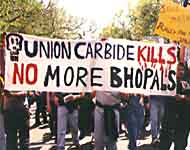
Twenty years ago, toxic chemical gas spilled from the Union Carbide plant in Bhopal, India, killing thousands, poisoning hundreds of thousands, and changing life forever for the inhabitants of that city.

Litigating Disaster is an account of the battle that the city's residents have faced in getting Union Carbide (a subsidiary of Dow Chemical)�to clean up and take responsibility for the toxic spill.

Watch a preview clip, and don't miss the film's premiere broadcasts around the December 3rd anniversary.

Greenpeace urges you to write to your representative to support Congressional Resolution 503 on Bhopal, and to get involved in their international campaign to clean up this toxic hotspot.

The International Campaign for Justice in Bhopal has a list of 20 things you can do to commemorate the day, and join the fight for justice for the victims of the Bhopal disaster.

These companies are your companies! Hold U.S.-based firms accountable for their practices overseas. Friends of the Earth has a current campaign for the International Right to Know Law�it would require American companies to disclose environmental, labor, and human rights information about their operations abroad.

Students for Bhopal and CorpWatch are two other organizations that are involved in the Bhopal campaign, and offer ways to take action.


  Giving Back the Light


During one week they will examine nearly 6,000 people, perform 180 surgeries and 380 eye surgeries, and give out 1,100 pairs of glasses and 269 hearing aids. They are a medical team from Boulder, Colorado that one week each year goes to their sister city of Mante, Mexico to bring desperately needed medical care. Learn more here.

Giving Back the Light tells the story of a group of American medical practitioners�who volunteer a week of their time each year to bring much-needed medical care to their sister city in Mexico.

Want to support their work? The volunteers get donations, including drugs and medical supplies, used hearing aids, wheelchairs, walkers, crutches and used reading glasses, from many sources. Contributions of money will help�to buy everything else they need for the yearly trip.
To send a donation, mail it in care of:

Boulder Community Hospital Foundation

1100 Balsam Ave.

P.O. Box 9019

Boulder, CO 80301-9019

You can check in on this year's trip, at the group's blog site.

Organize�your own community-to-community humanitarian effort.


  Clownin Kabul
     
  What can a pack of silly clowns do, in a war-devastated country like Afghanistan? Famed doctor and activist-clown Patch Adams shows us---in this documentary, Clownin' Kabul, filmed in 2002 soon after the U.S.-led attacks on the country. He takes his groups of clowns on humanitarian missions all over the world, to bring moments of laughter and happiness to some of the places where they are most needed.

Its depiction of the suffering that especially children endure as a result of run-ins with landmines has struck a cord in many of our viewers. If you'd like to help, there are many ways to make a difference:

Get involved with Patch Adams' Gesundheit! Institute: they've got lots of suggestions of how to do good works, and not all of them involve wearing gigantic shoes and a red nose. Although it never hurts. Their next clowning trip is to Russia�and you can help them to spread their revolutionary love message by buying a copy of the film, or just plain donating.

Support the doctors: The Italian medical organization Emergency and The International Committee of the Red Cross are two of the humanitarian groups whose brave work you see featured in Clownin' Kabul.

Roots of Peace is an American humanitarian group working to de-mine and re-plant the schoolyards and fields of countries like Afghanistan. They have a great project to get American kids involved in helping children who live in heavily-mined areas to reclaim a normal life.

And of course, join the International Campaign to Ban Landmines. The Bush Administration recently abandoned the international Mine Ban Treaty, and as the ICBL reports:
-The U.S. still reserves the right to produce antipersonnel mines, along with a dwindling list of 13 other producers.
-Although there is no evidence that the U.S. has used antipersonnel mines in its recent operations in Iraq or elsewhere, it still reserves the right to do so and this is cause for grave concern. The last time the U.S. used antipersonnel landmines was against Iraq in the 1991 Gulf War.

See their special report on the United States and landmines.

For more on Patch Adams' philosophy of true health, check out this interview he gave to a Chilean talk show, in 2003.